.png)
Micro-D or MIL-DTL-38999? High-Density Connector Selection for Avionics and Defence
Executive Summary
Micro-D and MIL-DTL-38999 solve different halves of the same problem. Micro-D wins on contact density per cubic centimetre; 38999 wins on shell integrity and environmental sealing. Most airborne systems end up using both, and the split is predictable.
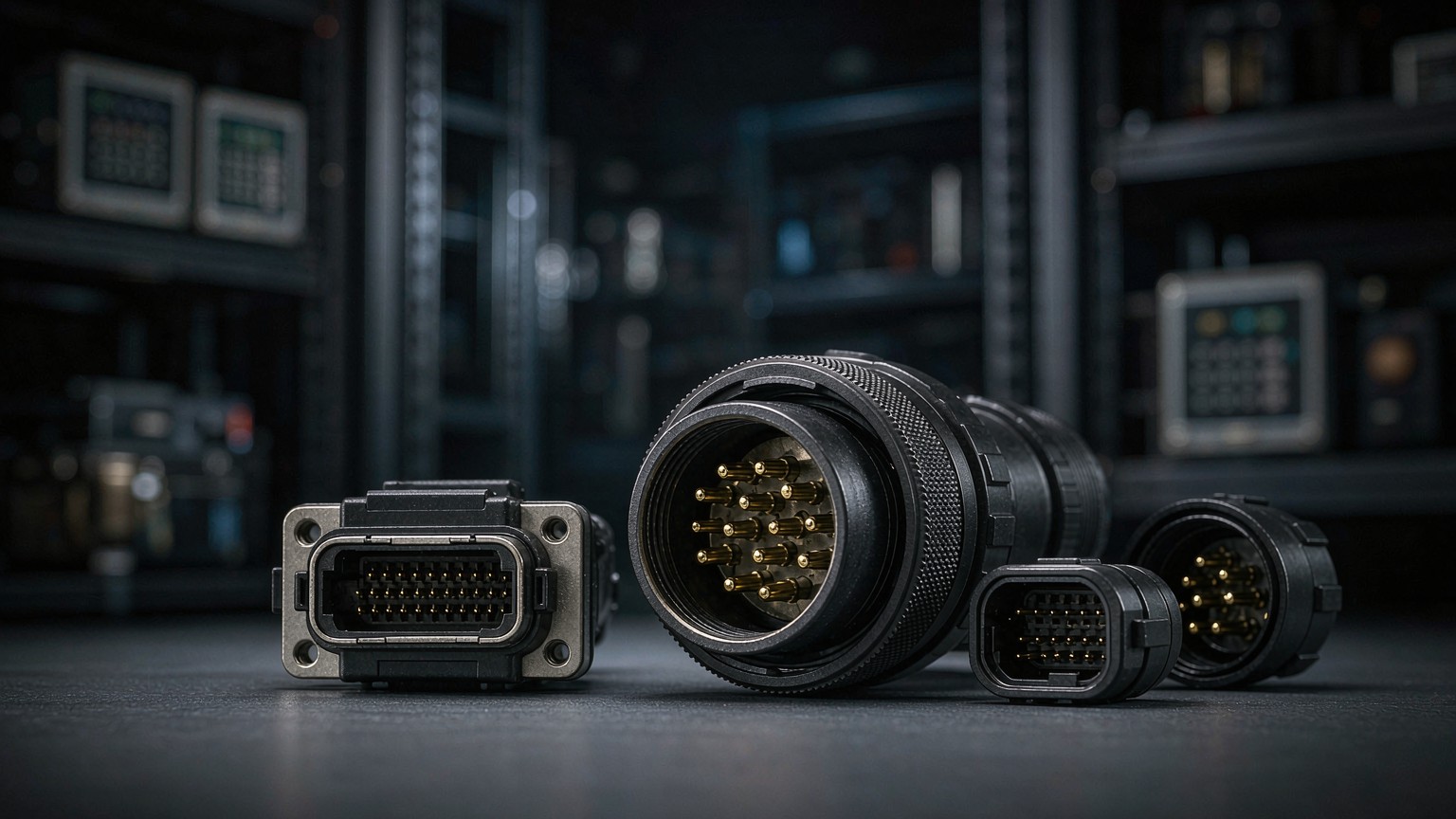
Two connector families dominate high-reliability signal distribution: the 1.27 mm pitch Micro-D, standardised as MIL-C-83513 and GJB2446, and the circular MIL-DTL-38999, which corresponds to GJB599. They are often specified against each other, but they are not really competitors — they sit at different points on the density-versus-ruggedness curve.
Micro-D: Density in a Rectangular Envelope
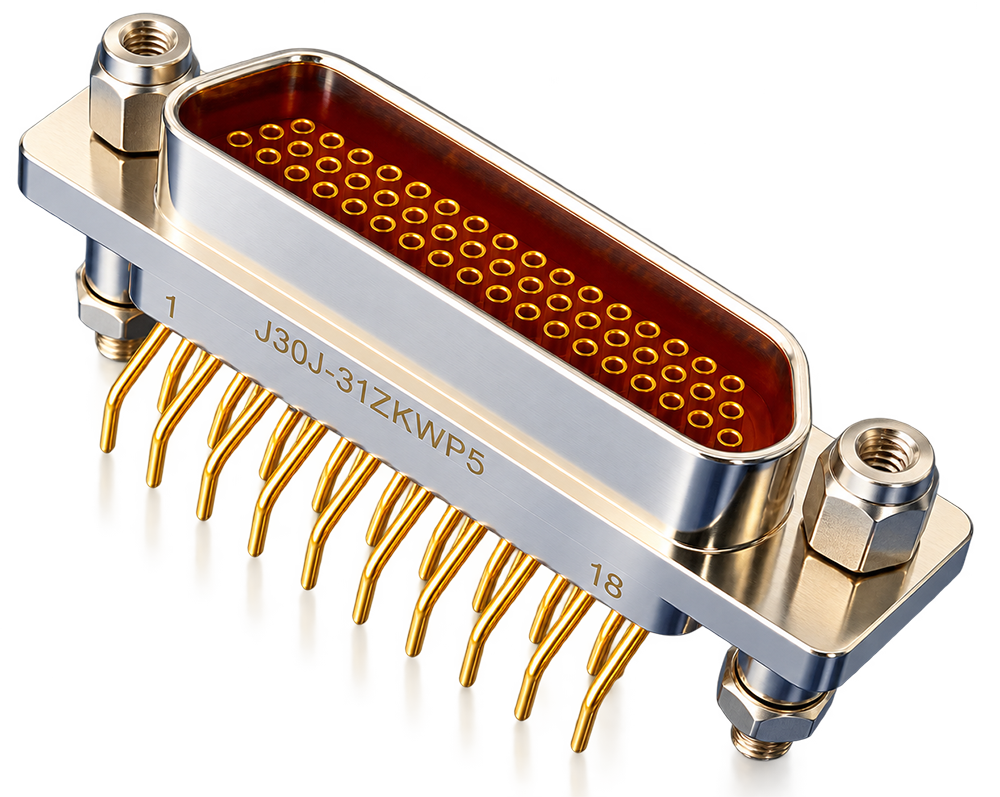
Our J30J series is built to GJB2446 / MIL-C-83513 with a 1.27 mm (0.050″) contact pitch. The rectangular shell packs contacts far more efficiently than a circular arrangement of the same footprint, which is why Micro-D appears wherever a board or a module needs dozens of signal lines in the smallest possible cutout.
The family branches to cover specific needs. J30JM1 adds hermetic sealing for modules that must hold a pressure boundary. J63A halves the pitch to 0.635 mm for the tightest layouts. J58A and the DXSM wire-spring series cover applications where contact wiping and insertion force matter more than raw density.
MIL-DTL-38999: Shell Integrity First
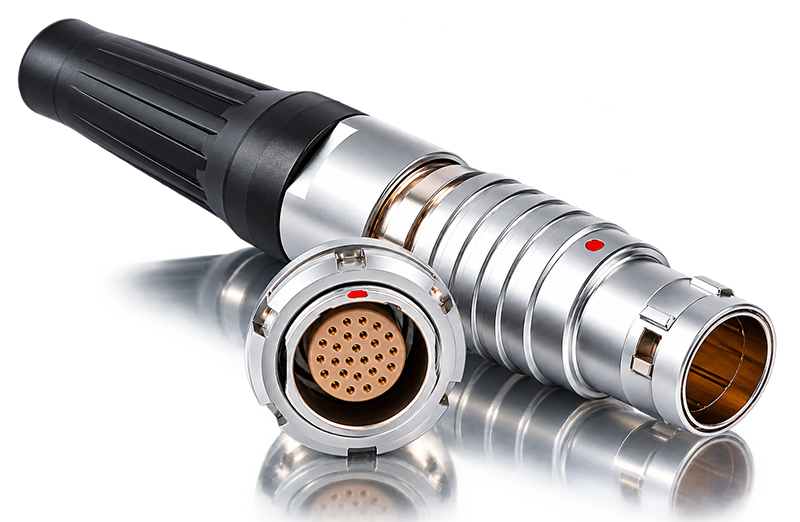
The GJB599 series is a circular connector built around environmental protection. The shell, the interfacial seal and the rear grommet form a sealed envelope around the contact system, and the threaded or bayonet coupling clamps that envelope under load. Where a Micro-D protects individual contacts, a 38999 protects the whole interface.
Three series levels are available: Series I for general-purpose use, Series II for lower-profile bayonet applications, and Series III with a finer thread and higher contact density. Series III shells come in both metal and composite versions — the composite shell cuts weight substantially and removes the galvanic corrosion path that appears when aluminium hardware meets a dissimilar metal.
The Usual Split
- Inside the box, Micro-D. Board-to-board, module-to-backplane and any run that never leaves the enclosure. Density and mass dominate; sealing is irrelevant.
- Through the wall, 38999. Anything crossing an equipment boundary, where the connector has to hold a pressure differential, survive fluid exposure and be serviceable with gloves on.
- Hermetic feedthroughs, J30JM1. Where the boundary is a sealed module rather than a whole airframe.
- Very high pin counts in tight spaces, J63A. When 1.27 mm pitch simply will not fit the available cutout.
What Actually Fails
In service, Micro-D failures cluster around contact displacement — a pin backed out of its retention clip during harness dressing, or a crimp that was never pull-tested. The rectangular shell gives no secondary indication that a contact has moved.
38999 failures cluster around the interfacial seal and the coupling ring. A seal contaminated at the last mate, or a coupling ring not fully seated, produces a joint that passes continuity testing and fails after the first pressure cycle. Torque marking and a mate-and-lock inspection step catch most of these.
Specifying a Mixed Harness
When a single harness uses both families, the practical decisions are tooling and documentation. Micro-D crimp tools and positioners are contact-specific; 38999 uses a different system entirely. Keeping one crimp platform per family, and recording which positioner belongs to which contact part number, prevents the most common assembly error we see in returned units.
Talk to a Hengyu application engineer:
Guangzhou Hengyu Electronic Technology Co., Ltd. · No. 188 Kaiyuan Avenue, Huangpu District, Guangzhou, China
Direct Inquiry Email: sales@hengyu-connector.com
Official WhatsApp: +86-20-87831269